
Reviewed · GOTHIC QUARTER TOURS
Barcelona Historical Walking Tour: Gothic Quarter and El Born
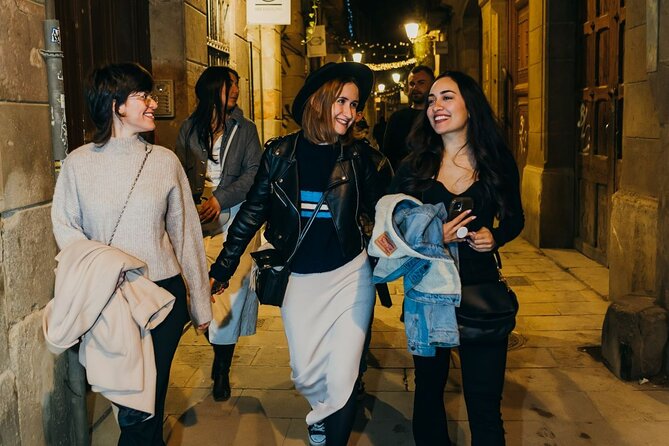
Barcelona’s old center is a place where a Roman wall can appear beside a Gothic church, and an ordinary-looking lane can carry centuries of stories. This two-hour walk links the Gothic Quarter with El Born, from the artists’ café Els 4 Gats to the maritime church of Santa Maria del Mar.
I like that you get both big landmarks and small details: a cathedral, a Civil War-scarred square, a photomosaic tied to Catalan history, and stories about Picasso and Gaudí. I also like the compact route, which reaches narrow streets that a bus tour cannot. One consideration: admission to Barcelona Cathedral and Santa Maria del Mar is not included, so the tour is chiefly an introduction to the sites rather than a ticketed church visit.
At a glance
- A route through two old neighborhoods: The walk starts in the Gothic Quarter and ends at Santa Maria del Mar in El Born.
- Eleven stops in about two hours: Each listed stop is planned for roughly 10 minutes, with walking time between them.
- Stories connect the sights: Expect Roman remains, medieval Barcelona, Catalan identity, the Civil War, and artists such as Picasso and Gaudí.
- Small-group scale: The maximum is 20 people, a useful limit in narrow lanes where a large group can be hard to manage.
- A low-cost introduction: The price is $30.25 per person, but entry to the two named churches is extra if you want to go inside.
Start among Roman stones and artist lore
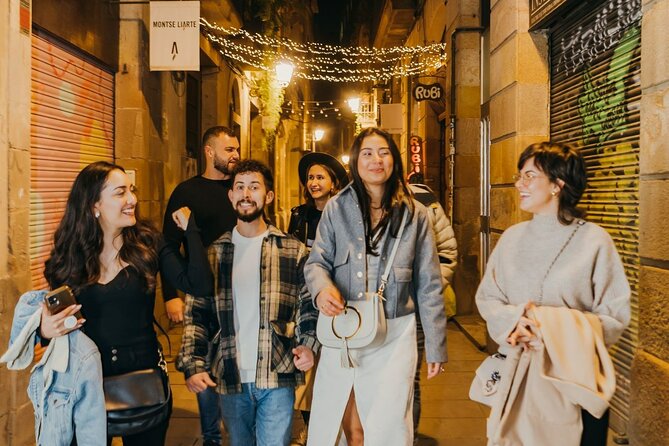
The meeting point is Plaça del Vuit de Març, in Ciutat Vella. From there, the route sets out through the old center on foot. This is a practical way to begin a Barcelona visit: you get a sense of how the neighborhoods fit together, and your guide can point out details you could easily pass without noticing.
One early stop is Els 4 Gats, a historic café and restaurant associated with artists, intellectuals, and modernists. Picasso and Gaudí are among the names connected with the place. Its Art Nouveau design gives the café a visual character that suits its artistic past, while the guide’s stories help put those famous names into the setting of Barcelona’s cultural life.
The tour does not include an admission ticket here, and the stop is listed for about 10 minutes. Think of it as a brief look and an introduction, not a long café visit. If you want to linger over a meal or study the interior, plan that for another time.
Next comes El Mon Neix En Cada Besada, a photomosaic installed in 2014. Its connection to the Catalan defeat of September 11, 1714, turns a public artwork into a marker of collective memory. That date is tied to La Diada, Catalonia Day, and the work offers a way to talk about freedom and identity in Barcelona today.
This is one of the walk’s more useful contrasts: the city’s past is not only Roman stone and royal rooms. It also appears in public art and in the meanings residents attach to a date. The stop is short, so the guide’s explanation matters. You can take in the mosaic quickly, but the context gives it weight.
More Gothic Quarter walks in Barcelona:
- Barcelona all included: Sagrada, Park Güell, Montjuic & Gothic
★ 5.0 · 2,169 reviews - Barcelona Gothic Quarter Tapas & Taverns Food & Wine Tour
★ 5.0 · 1,470 reviews - Barcelona: Gothic Quarter Ghosts and Legends Walking Tour
★ 4.7 · 1,443 reviews
Gothic Barcelona, from cathedral to bishop’s bridge
Barcelona Cathedral stands at the heart of the Gothic Quarter and is dedicated to Saint Eulalia, the city’s patron saint. The story of her torture and death at Roman hands connects the church to the city’s early Christian past. Its Gothic design makes it a natural focal point, but the tour does not include admission, so budget separately if entering the cathedral is important to you.
The next stop, Casa de l’Ardiaca, brings together Gothic and Renaissance elements. The building is also a place to see the vertical face of the Roman wall and remains of aqueducts. That layering is part of what makes the old center so satisfying on foot: eras sit close together, and a guide can help you distinguish what belongs to which period.
At Pont del Bisbe, a Neo-Gothic bridge crosses Carrer del Bisbe. The street followed one of the main routes through Roman Barcino, and the bridge is tied to a superstitious legend. The supplied details do not spell out the tale, which is a good reason to listen closely when your guide tells it. The bridge is a short stop, but it offers a memorable pause in the walk and a story to carry forward.
Plaça Sant Felip Neri is quieter in mood. Its history is linked to the Spanish Civil War, and the scars on the square remain visible reminders of that past. The setting may look picturesque, but the guide’s account gives the place a more serious dimension. It is an important counterweight to the tour’s lighter anecdotes about artists and legends.
You get a concentrated lesson in how this part of Barcelona works: a church tells one story, a street traces an older route, and a square holds the marks of more recent conflict. That variety is a strength of a guided walk. Instead of treating the Gothic Quarter as a pretty backdrop, the tour connects its buildings and public spaces to events and people.
El Call and the city’s political heart
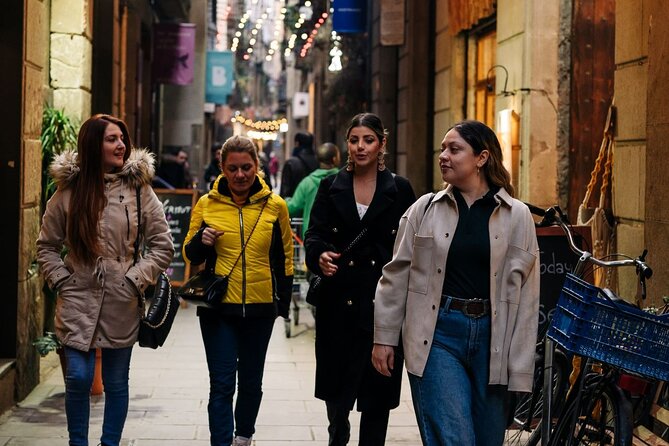
The route continues into El Call, Barcelona’s former Jewish quarter. Narrow streets and medieval architecture provide the setting for stories about the city’s Jewish history, including its synagogue and local legends. This is an area where the street pattern itself matters. A guide can give you context for what you are seeing, rather than leaving you to guess what life here may have been like.
Plaça de Sant Jaume shifts the focus from neighborhood lanes to government. The square remains a hub of civic activity, surrounded by historic buildings. It is a useful place to see that the old center is not a museum district frozen in time. Political life still occupies these streets and squares.
At Plaça del Rei, the Royal Palace frames a square that looks calm and handsome. The stop also points toward a darker part of Barcelona’s past. The itinerary does not specify which episode the guide will emphasize, so expect the square to serve as a setting for stories rather than a full visit to the palace interiors.
Then comes Plaça de l’Àngel, once known as Wheat Square because of its role in grain trading. Its current name is connected to a heavenly legend. This kind of stop is modest in scale, yet it helps explain how an everyday place can collect layers of meaning over time: commerce first, a story attached later, and a modern name that preserves the tale.
The itinerary gives each of these squares about 10 minutes. That is enough for an explanation and a look around, but not enough to explore every building or side street at length. If one place especially catches your attention, make a note to return on your own after the tour.
Finish at Santa Maria del Mar
The final stop is the Basilica of Santa Maria del Mar, in El Born. This Catalan Gothic church is linked to Barcelona’s maritime history and makes a fitting end to a walk that has moved through religious, civic, artistic, and commercial parts of the old city.
Admission is not included here either. You can appreciate the church as the route’s endpoint, then decide whether you want to pay separately to enter. The tour ends at Plaça de Santa Maria, 1, so you are left in El Born rather than returned to the starting point. That makes the ending useful if you want to continue exploring the neighborhood.
The sequence also gives the tour a clear shape. It begins with artists and public memory, moves through the Gothic Quarter’s churches and lanes, then ends at a major church associated with the city’s maritime life. The route is not just a checklist of buildings; it sketches several forces that shaped Barcelona.
More walking tours in Barcelona:
- Barcelona Tapas and Wine Experience Small-Group Walking Tour
★ 5.0 · 5,804 reviews - Barcelona: Tapas Walking Tour with Food, Wine, and History
★ 4.8 · 4,261 reviews - Barcelona Tapas Walking Tour: Food, Wine & History
★ 4.5 · 1,928 reviews - Barcelona: Tapas Food Crawl Walking Tour with Tastings
★ 4.9 · 1,798 reviews
What the guide adds
The main value here is interpretation. Roman walls, medieval streets, and church facades are visible without a guide, but the stories help you connect them. Past guides named for the tour include Juan, Lidia, Vanesa, Jordan, Darren, Petra, Sonia, and others. Guide assignments can vary, so you should not book expecting one particular person.
The descriptions of those guides point to strengths worth looking for: clear explanations, humor, local traditions, and an ability to answer questions. Juan is associated with using an iPad to show historical images and offering suggestions for food, attractions, restaurants, and bars. Tammy has been noted for sending food and drink recommendations after the walk. Those touches can make a short tour useful beyond the two hours themselves.
There are also occasional differences in delivery. One account described a guide who spoke too softly for the group to hear, while another praised a guide who kept a relaxed pace and made time for photos. A maximum of 20 helps, but it cannot guarantee that every person will hear every explanation. If you are toward the back, move closer when the guide begins speaking.
Is $30.25 good value?
At $30.25 per person, this is a fairly affordable way to get an organized introduction to two of Barcelona’s oldest neighborhoods. You are paying for a local guide, a two-hour route, and the context that turns streets and facades into a connected story. Group discounts are available, though the amount is not specified.
The value depends on what you want. If you enjoy walking and want a quick orientation before exploring on your own, the fee makes sense. The route covers 11 stops, and the small-group cap is more manageable than a large coach outing. The guide can also point out places you might otherwise walk past.
It is less compelling if you want extended time inside churches, museums, or cafés. The cathedral and Santa Maria del Mar do not include admission, and each stop is brief. Treat the tour as a guided overview, then return to the places that deserve more time.
The tour is offered in English and uses a mobile ticket. It lasts about two hours, and the walk is described as easy and doable for most people. Morning is a sensible choice if you have one available: the streets tend to be cooler and less busy then. The route is near public transportation, and most people can participate.
Bookings are made, on average, 26 days ahead, so planning early is sensible if your dates are fixed. Free cancellation is available up to 24 hours before the start time; cancellations made later are not refunded. The tour operator is Carpe Diem Tours.
Who should book this walk?

I would choose this tour for a first or early day in Barcelona, especially if you want a readable introduction to the Gothic Quarter and El Born before returning to explore independently. It suits visitors who like history in short, digestible chapters, and families may appreciate that guides have kept children and teenagers engaged.
It is also a good fit if you want a walking route through places a bus cannot reach. Wear comfortable shoes and be ready to walk through old streets, pause often, and listen in busy surroundings. The route is not described as strenuous, but it is still a two-hour walk.
Skip it if you prefer to set your own pace, spend a long time inside each church, or avoid group tours altogether. For most people looking for a compact orientation, though, the combination of Roman traces, medieval lanes, Catalan memory, and local storytelling offers a useful start.
FAQ
How long is the Barcelona Historical Walking Tour?
The tour lasts approximately two hours.
How much does the tour cost?
The listed price is $30.25 per person. Group discounts are available, but the discount amount is not specified.
What language is the tour offered in?
The tour is offered in English.
Where does the tour start?
It starts at Plaça del Vuit de Març in Ciutat Vella, Barcelona.
Where does the tour end?
It ends at Basílica de Santa Maria del Mar, at Plaça de Santa Maria, 1, in Ciutat Vella.
How many people can join the group?
The maximum group size is 20 people.
Are church admission fees included?
No. Admission to Barcelona Cathedral and Santa Maria del Mar is not included. The other listed stops have no admission ticket charge.
What is included in the price?
The tour includes a guided walking tour, a local guide, city highlights, and lesser-known stops.
Can I cancel for a refund?
Yes, you can cancel for a full refund up to 24 hours before the tour’s start time. Cancellations made less than 24 hours before the start are not refunded.
More history tours in Barcelona
- Barcelona: 2.5-Hour Bike or E-Bike Historical Tour
★ 4.5 · 1,262 reviews - Barcelona Erotic Museum – Explore Art, History & Fun
★ 4.4 · 450 reviews - Andorra Original History and Sightseeing Tour (Private, Pickup)
★ 5.0 · 350 reviews - Barcelona: Dark History Night Walking Tour
★ 4.8 · 344 reviews
Reviewed this season in Barcelona
- Two Hour Luxury Sailing Experience with Open Bar★ 4.8 · 13 reviews
- Sunset from a private Classic Yacht★ 5.0 · 3 reviews
- Stories, Legends and Mysteries of Barcelona★ 5.0 · 14 reviews
- Skip-the-Line Barcelona & Montserrat Tour with Pick-up★ 4.6 · 47 reviews
- Skip-the-line Montjuïc Castle Tour with a Cable Car Ride★ 4.7 · 7 reviews
- Barcelona: Old Town & Seafront Segway Tour★ 4.9 · 145 reviews
- Shore Excursion of Barcelona★ 4.9 · 4 reviews
- Barcelona Highlights Half Day Small Group Tour★ 5.0 · 4 reviews
Gothic Quarter Tours, compared.
Barcelona all included: Sagrada, Park Güell, Montjuic & Gothic
Read our review →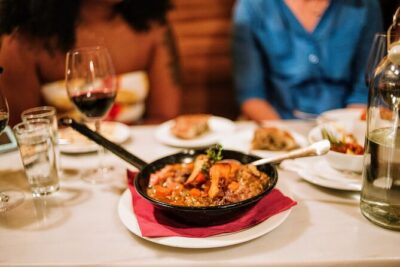
Barcelona Gothic Quarter Tapas & Taverns Food & Wine Tour
Read our review →
Gothic Quarter Ghosts and Legends Walking Tour
Read our review →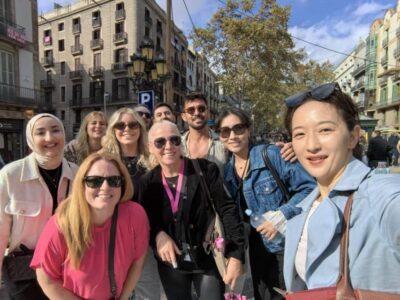
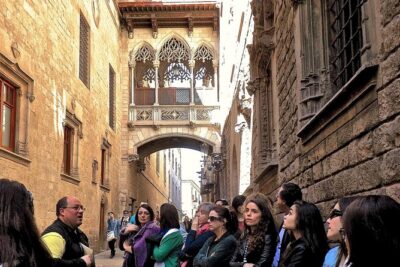
Barcelona Old Town & Gothic Quarter Small Group Tour
Read our review →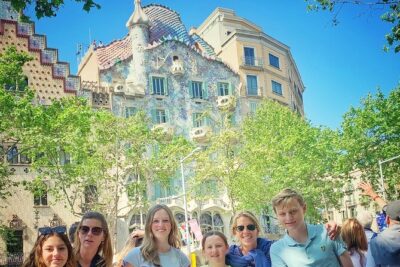
Ramblas, Old Town, Gothic and Gaudi Architecture Walking Tour
Read our review →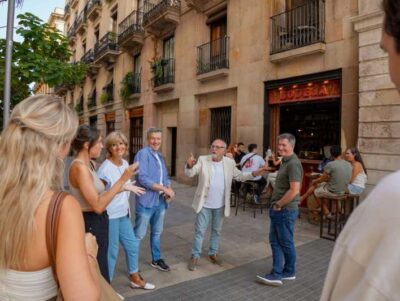
El Born and Gothic Quarter Wine & Tapas Bar Tour
Read our review →
El Born Food Walking Tour with Tapas and Drinks
Read our review →Browse the lists this tour appears in